You probably don’t know me, let me talk about myself. I started to get familiar with computers since my teenager age, especially on the software side with programming. Of course, looking back now, much of what I did was quite amateurish. But this is not a bad thing, because it means that I have been got more knowledge and improved myself. After the colleague, I have been working on different companies and fields. Meanwhile, talked with people in person, or on the internet (forums, conference, reddit, discord, and so on). I have been working in factories with conveyors and robots and within IT with infrastructure (on-prem). But I always had one thing that was common in each of my jobs: automation.
I have always considered myself a lazy person — in a good way. I enjoy creative tasks, but doing the same thing over and over? That drains me. On the other hand, I love technical challenges. I think that mix is what drew me to the beauty of automation. It’s been a constant thread throughout my entire career.
📣 Important
I can assure you, this article is not the “Holy Grail”. I write my view, feelings. It may (partially) match with yours and you agree. But if it does not, you don’t have to be mad. You have your authority to have your own feelings and views. At the end, we are all wired differently.
I have never liked those people who are enforcing their view or will on other even if they are not involved into that specific things. But I am open to discuss new things, and having a good discussion with pro and contra. My post is something that I meant as a “discussion starter” in the topic.
It also important to note, that I do not talk about tooling here. The approach what you are using, is up to you. This is not a technology promo, this is not an AI promo. These are just thoughts that I share.
Humanity always wants to learn
With or without any will, humanity went to a direction that provides a smoother life with more comfortable services. Time to time, we improved our tooling that provided better living environments. Let’s see a few example what I mean.
In the distant past, cavemen used stone tools like axes and knives. Later, they invented more reliable tools made from bronze. These tools lasted longer, required less time to recreate, and freed up time for other tasks.
A more recent example is the widespread use of steam engines. They completely changed people’s lives. Instead of relying on manual labor, we could shift the work to machines. With the extra time, humanity could invest more in science and innovation.
Although the desire to improve tools, in time of cavemen, were due to survival instincts, but in the last few century, it has been changed. People start to explore and discover how they can have better life. Nowadays, automation has a huge impact on the word: from some view positive, from some view negative effect.
Why do we automate?
Generally speaking, we are automating because:
- Save time.
- Reduce errors (or getting more consistent errors).
- Free ourselves from repetitive tasks.
- Recover from problems quickly.
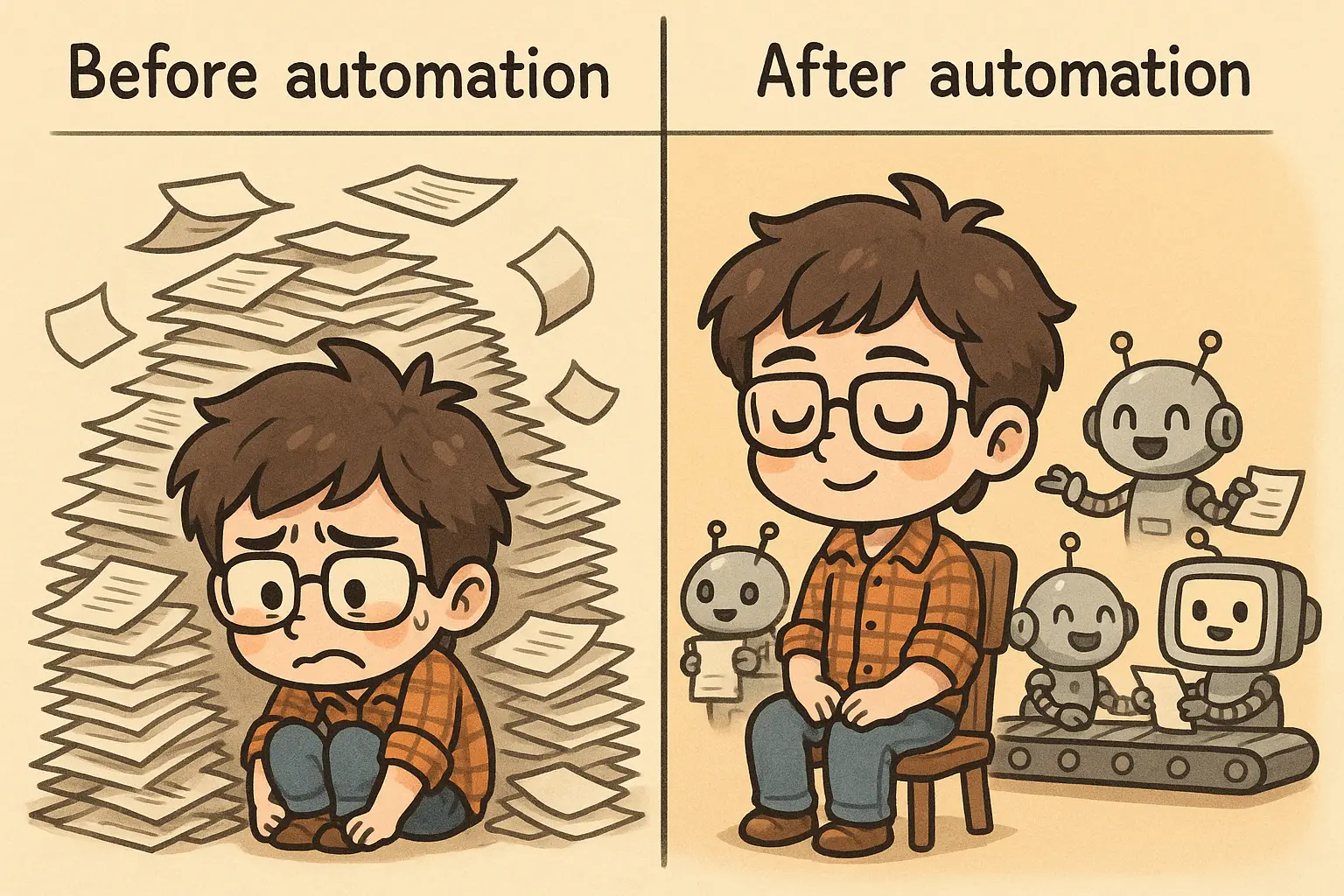
But the motivation behind automation can vary. A CEO and an engineer may see it very differently. I’m writing from an employee’s perspective. Automation isn’t evil — it does not eliminate jobs, it transforms them.
They followed the check list… Most of times
I have seen many cases where the root cause of an issue was human error, even when everything was carefully planned. Why? Because we’re human, not robots. We can get distracted, and that affects our work.
I never blame someone for a mistake — at least not the first or second time. But if someone keeps making the same mistake repeatedly, it’s time to reflect on why.
My opinion, when issue like this happen, we should not blame the person. Instead, we should analyze what were happening and how it could have been prevented. And this is where automation fit to the image. Even if the process cannot be fully automated, but partially it can be.
Let’s see how automation can improve someone’s life.
Direct and indirect effects of automation
- Does not person have enough knowledge on the specific field?
- Automation can reduce the entry barrier and make every day tasks more accessible.
- Are they overwhelmed?
- Automation reduces prep, execution, and post-execution time — saving mental energy.
- Have they lost the motivation?
- I have seen burned out people. Automation will not fix that, but free up some time that can reduce the stress and improve mood.
Believe me or not having more time – not being under constant pressure – can powerfully motivate. I remember, when I used to start to work with my job, I scripted tasks that were part of my routine, like user management. Over the time I improved on these scripts, bit by bit. I have a core memory, when I showed this to my colleagues, their feedback was: “Good, but nobody will use it.”
I was really hoping for a kinder feedback. And they were right. Nobody did use them but me. And few years later, they were asking me: “How do you have such lot of time to get things done?”.
You may think, this is a made up story, but I can assure you: it is not. Of course, it is up to you, that believe me or not.
The legacy is not lost, just shared
Computer systems has become more and more complex. It is natural: world has more and more demands, that requires infrastructure evolution. For those, who are newer on this topic, it is more difficult to “jump in”, start to work and be effective. Because the required level knowledge is just getting higher. Not every person has patient or ability to read books for weeks or months just to make something basic.
I often hear arguments like: “If they do not know what is happening, they will never know what when something break.”. Let’s walk through that.
If I want to write to disk into a file, do I really have to know how a block device driver works or knowing which system call or SVC is called? No. If something goes wrong, I can check the documentation, review logs, and investigate the issue without understanding every internal detail.
If you’re experienced, scripting repetitive tasks helps. When new junior colleagues join, they can be productive more quickly, and it gives them a morale boost. They feel useful. Meanwhile, senior team members can delegate earlier — freeing up time to learn, teach, document, or work on higher-level problems.
Automate instead of burning out
If you’re experienced, don’t hesitate to script and delegate. Early in my career, I made the mistake of doing too much myself. I didn’t delegate. I took on too much. Eventually, I came to a realization: I couldn’t keep doing it alone. I started automating small pieces of my work. Then I delegated. Later, I organized training sessions to spread knowledge. It wasn’t easy — change rarely is — but it made a difference.
Bad side of automation
Just like everything, automation also has a bad sides. Most of the bad sides, in my experience, coming from people.
Tools are changing, habits remain
This topic is not automation specific topic, rather a human trait. The technology evolves quickly, and it is difficult to keep up with it, mainly if the person working with the same tool set and mindset for more decade.
And to be fair, they have a point: if something has worked reliably for years, why should we change it? It is stable, make sense, until it does not.
If you stick with old tools, you missed the opportunity to grow. Sure, not every new piece if better, but some are.
And if you isolate yourself, the system you maintain might be stable… Until, you are gone. Then no one knows how to handle it, and people will throw away since it becomes technical dept. That is sad, especially if you have invested more years in it. I would feel bad the my ideas were discarded just because I did not make them sustainable.
If you do not want to be part, that is fine – just do not be a blocker
If automation feels outside of your comfort zone, do not want to be involved, that is fine. But please, do not be a road block in front of others.
What frustrate me, if people sabotage progress. Some discourage juniors from “breaking the habit”. Some seniors panic when juniors knows something they do not. They are afraid to ask for help, because they think: “I’m the seniors. I should know everything.”.
But to me, a senior isn’t someone who knows every command or memorized every manual. A senior is someone who can glue things together and solve real problems.
Sometimes, it is not easy with other people
A few years ago, I worked with some very experienced engineers from Germany (30-40 years of service). We had to migrate systems from one location to another. The plan was not complicated, but due to hardware change, some recalibration on low-level settings must have been done.
Their proposal – based on decades of experience – was to copy the system, make changes manually, then start it. That is how they were always working.
I suggested another approach: make some preparation on source system and on the new location, script the changes. After hours of debate, they let me try.
On the day of the change, we finished 2.5 hours ahead of schedule, compared their historical estimate. It has become a core memory.
People will always resist change. Just like when steam engines were introduced, some people tried to destroy them in protest. But where are those people now? And where is the technology?
That precious comfort zone
“I don’t need to learn new things. I’m fine. Besides, I’m not willing to do extra work for the company.”
I hear that often. And here is my approach: I do not learn for the company. I learn for myself. This sounds selfish, but it is survival instinct. Every script, document, design I create, belongs to the company. But my thought, are mine. When I leave, I take them with me.
So learn for your own growth. The worst case scenario? You switch job and confidently ask for higher salary because your have earned it by increasing your value.
How to start?
Nothing changes overnight. What my team and I do is take small steps. Every week or month, we improve something – just a little. Overtime, it sums up. You would be surprised how much more efficient everything becomes. And it boosts morale too.
Not sure where to start? Pick a technology you enjoy. There’s no such thing as a “holy grail” tool. Every online post recommends something different.
My advice: just start learning. Every time you learn something new, it becomes easier to learn the next thing. It is like an RPG skill tree: as you earn points, each new skill becomes more accessible.
Some skills — like Python — are always useful in IT. But don’t be afraid to experiment with other tools. Try things out. See what sticks.
Final words
At a high level, this is how I see automation. In my opinion, it is a good direction in almost any field — at least in IT and factory work, where I have experience.
I know it is hard to leave your comfort zone. But if you step out together, you can support one another.
It is a good thing. Just start — and you will enjoy the results.
I remember when I used to work weekends, from 1 AM to 3 AM, because production changes had to be done then.
But for almost two years now, I have not had to do any of that — all thanks to automation.
Now, I sleep peacefully on Saturday and Sunday nights.